



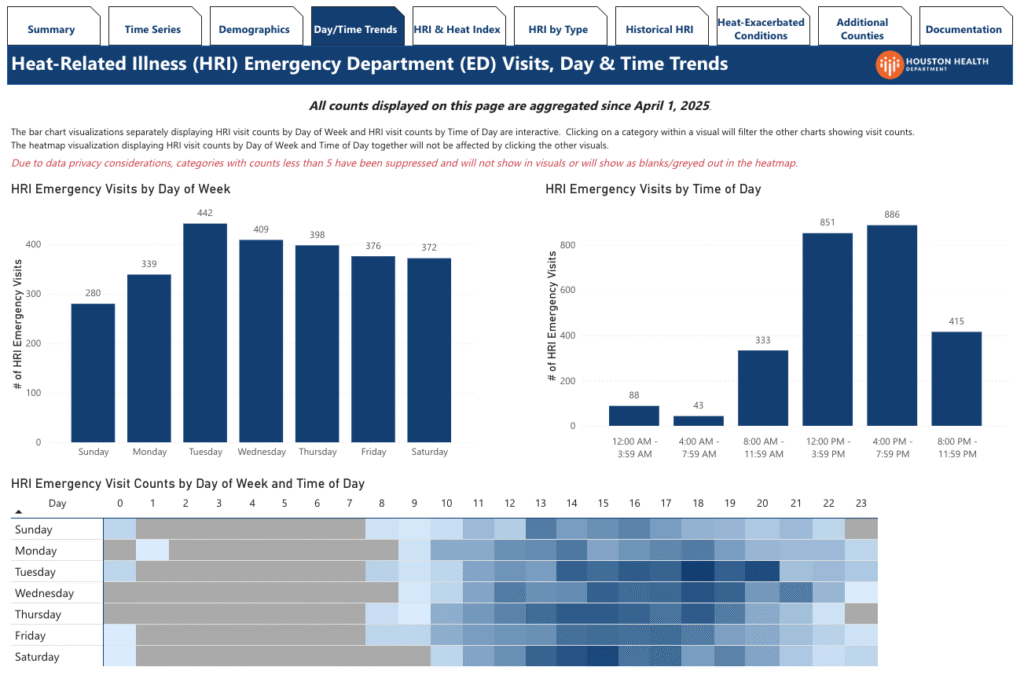
As extreme heat continues to be a public health threat, the Houston Health Department (HHD) closely tracks Heat Related Illnesses (HRIs) and other health conditions that can be exacerbated by heat through queries developed by the HHD and other public health entities, as well as CCDD categories within the ESSENCE® application. To help identify vulnerable populations and formulate interventions to protect the community from extreme heat events, the Houston Health Department developed an interactive dashboard that tracks heat index and health data in the Houston area.
Heat Related Illness occurs when individuals are unable to cool down due to high temperatures and lack access to shade or water. Other underlying health conditions such as acute kidney injury, preterm birth, stroke, and more may be worsened, or exacerbated, by extreme heat. Understanding trends with HRIs throughout the community can help identify the most vulnerable populations and inform interventions to keep people safe. However, tracking these trends can be difficult, as there are many different types of Heat Related Illnesses and emergency department records might not collect information about HRIs in a uniform fashion, necessitating a system that can quickly query the data with a standard definition.
ESSENCE® provides a standard definition for HRIs, including heat exhaustion, heat stroke, heat syncope, heat cramps, heat rash, dehydration, and hyperthermia. InductiveHealth’s support of Houston’s local instance of ESSENCE® enabled the ability to integrate data into the Department’s data visualization platform, which provided the basis for the easy-to-understand public facing dashboard.
Overlaid with weather, geographic, and other health and medical data, the Houston Health Department can better understand what communities and populations are most vulnerable to HRIs, allowing the health department to execute tailored and preventative intervention strategies. The interactive, public facing dashboard is updated once a week between April and October, and it helps improve the public’s understanding of how heat impacts the Houston community. The dashboard allows community members, researchers, and local media to see trends over time and compare them across historical data. In addition, it provides important data on heat exacerbated conditions that require emergency department visits, including homelessness, acute kidney injury, asthma, drowning, firearm injuries, and vector borne diseases like dengue fever and Zika virus.